Dignity Without Permission
Reflections for March during celebrations of Women’s History Month, recognition for International Women’s Day, and a tribute to women’s peace and justice advocate Mavic Balleza Cabrera.

By Rev. Dr. Liberato (Levi) C. Bautista
This month of March has been a busy time of celebration, as well as debate concerning the global social and justice issues surrounding women. I share my reflections with a heavy heart as we lost a luminary for women justice advocacy. On March 20, 2026, while the Seventieth UN Commission on the Status of Women (CSW70) Event was in progress in New York City, Mavic Balleza Cabrera passed away peacefully in her home city of Manila, Philippines.
The founder and CEO of the Global Network of Women Peacebuilders, based at the Church Center for the United Nations, Mavic influenced movements worldwide. She was a symbol of gender justice and peace. Her passing is deeply mourned, yet it also serves as a powerful reminder the impact and influence she generated in the past, now in the present and for the future. This March Edition of The Present Tense is a tribute to Mavic, her legacy, and memory of a long-time, dear friend.
CSW70 aims to improve access to justice for women and girls by removing discriminatory laws, protecting abuse survivors, and tackling systemic barriers. In March, I spoke at three side events on leadership, breaking trafficking profit chains, and the ethics of multilateralism to uphold human dignity. Mavic Balleza Cabrera attended CSW70 multiple times and served as a guest speaker.
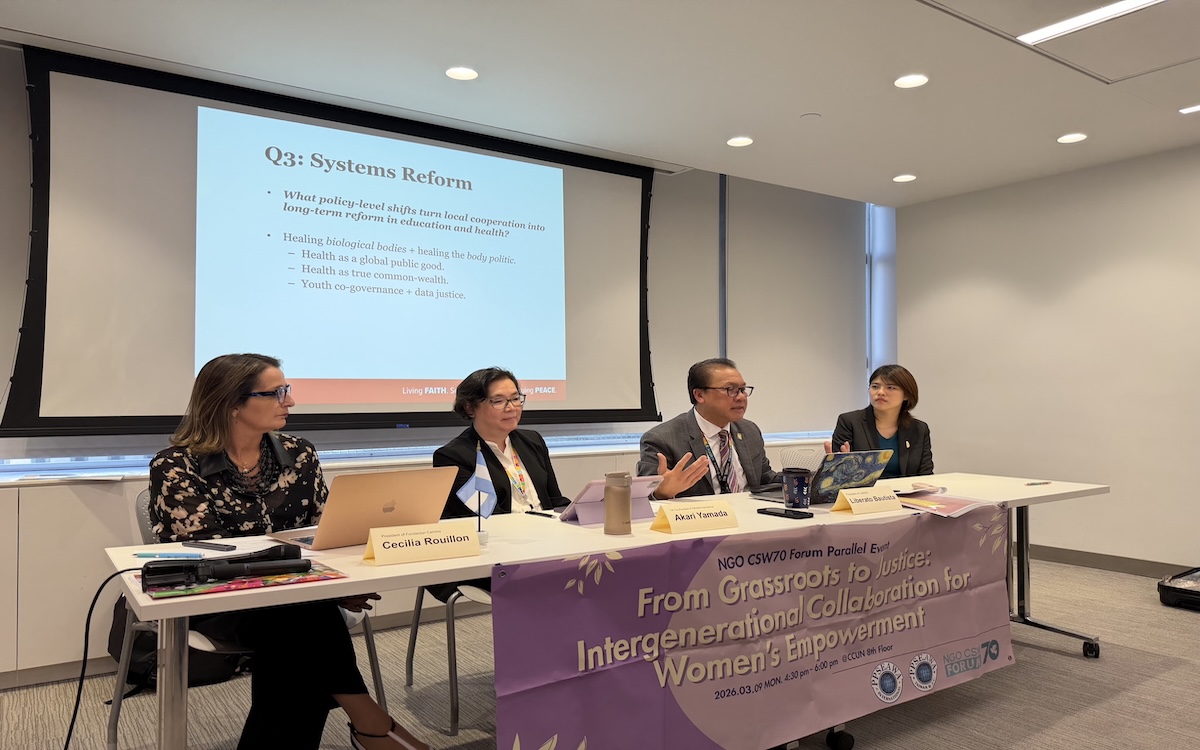
Young Women Leading with Authority
Attending a Pan Pacific South East Asia Women’s Association event led by young women emphasizing that gender justice has no age minimum, I arrived humbly. As a man in a space shaped by women and girls’ experiences, I recognized that masculinity must be unlearned and relearned in pursuit of justice.
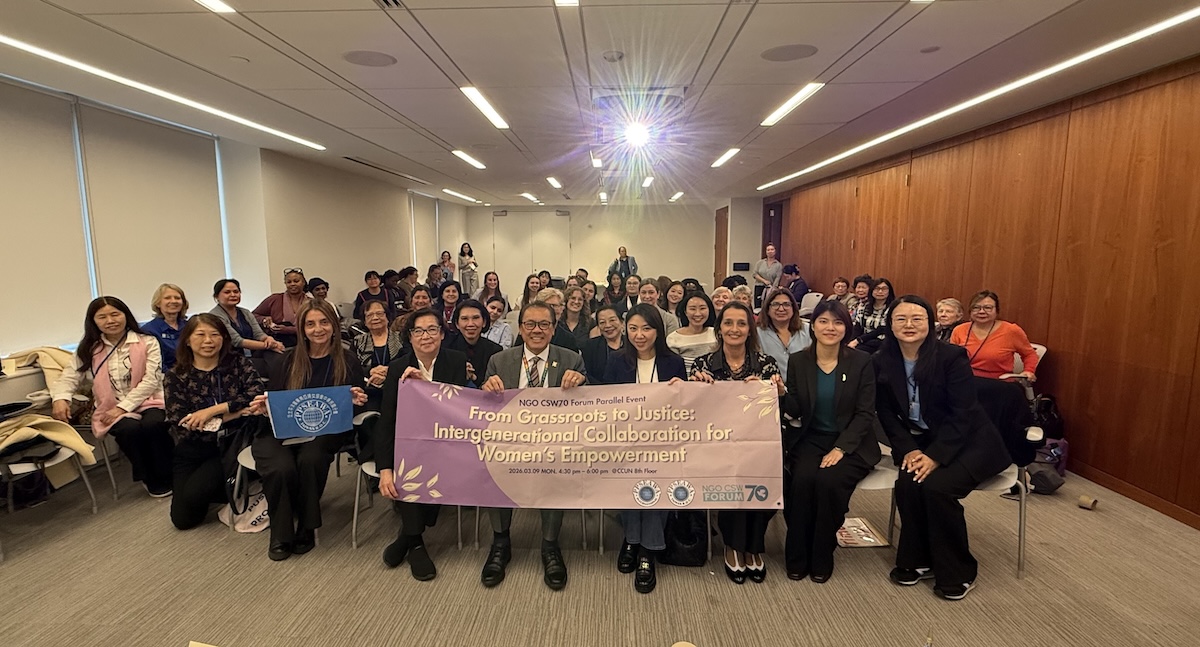
These young organizers exemplified CSW70’s mandate that women and youth, including girls, actively participate as co-authors of justice systems and policies. Their leadership illustrated frameworks that Church and Society advocates through Churches Witnessing With Migrants (CWWM): an infrastructure of welcome and hospitality, and an architecture of protection and solidarity.
In their hands, these frameworks became active practices, showing that intergenerational leadership is a real redistribution of authority, and justice starts when women and girls feel empowered to speak truth without permission.
Dismantling Profit Chains and Protecting Survivors
At a human trafficking-focused event hosted by the National Association of Women of Uganda, the Permanent Mission of Uganda, and partners, I reflected on CSW70’s call for survivor-centered justice. Human trafficking profits from commodifying bodies and monetizing fear, relying on gender inequality, poverty, and unsafe migration routes.
If justice is to be meaningful, it must extend as widely and swiftly as exploitation does. Systems require reorganization to ensure that the law advances alongside survivors, rather than compelling survivors to navigate borders, bureaucracy, and disbelief.
Enhancing cross-border cooperation is essential; remedies must be readily accessible; discriminatory laws must be abolished. Absent these measures, justice remains superficial—commendable in rhetoric but absent in implementation.
The Ethical Grammar of Multilateralism
During the event hosted by the NGO Committee on Spirituality, Values, and Global Concerns, I reflected on the core principles supporting multilateralism. Institutions need to review, address, and improve their practices—especially when women share experiences of harm in environments that haven’t consistently protected their well-being. This collective reflection emphasizes the importance of collaborative efforts to create safer and more inclusive spaces.
Luiza Brunet, a Brazilian women’s rights advocate, reminded us that vulnerability is not a sign of weakness but evidence that must be respected, protected, and acted upon. The United Nations, though imperfect, remains a vital global forum where dignity can transform into policy and justice becomes a duty. Ethical multilateralism might still turn lived truths into shared responsibility.
Wesleyan Social Holiness and the Indivisibility of Women’s Rights
The United Methodist commitment to women’s rights arise from a Wesleyan understanding of social holiness, inspired by John Wesley’s call to “do all the good you can,” which encourages public courage.
The United Methodist Social Principles affirm the worth of every woman and girl and see gender-based violence as an assault on God’s image.
The UMC Social Principles urge United Methodists to embody justice, not just talk about it. For example, as an United Methodist, check if your country is implementing the Palermo Protocol, an international treaty against human trafficking that aligns with United Methodist social teachings. For more action ideas, see Church and Society’s Human Trafficking Faith & Facts Card
Accountability and the Future We Owe
As we observe March Women’s History Month and International Women’s Day, a question arises: Does the world we build enable every woman and girl to speak, stand, and flourish without fear or shame?
Though my voice isn’t central to this struggle, I remain committed to it, especially to the global communities I serve, and to my four granddaughters, who will inherit a world shaped by today’s decisions. For them and all daughters, the fight for gender justice must not be delayed or delegated.
Spanning almost 40 years, my vocation has been influenced by the global ecumenical movement, faith-based advocacy, the UN, and cross-border communities. My experience affirms that faith is public, dignity is inherent, and justice must be actively pursued.
Ethical multilateralism and Wesleyan social holiness strive to transform systems, individuals, and masculinities for positive change.
I continue this work because dignity is not just an accessory of policy; it is its goal. And justice must guide its approach.
The Present Tense, a monthly column of reflection, is written by Levi Bautista, Assistant General Secretary for United Nations and International Affairs of The General Board of Church and Society of The United Methodist Church.